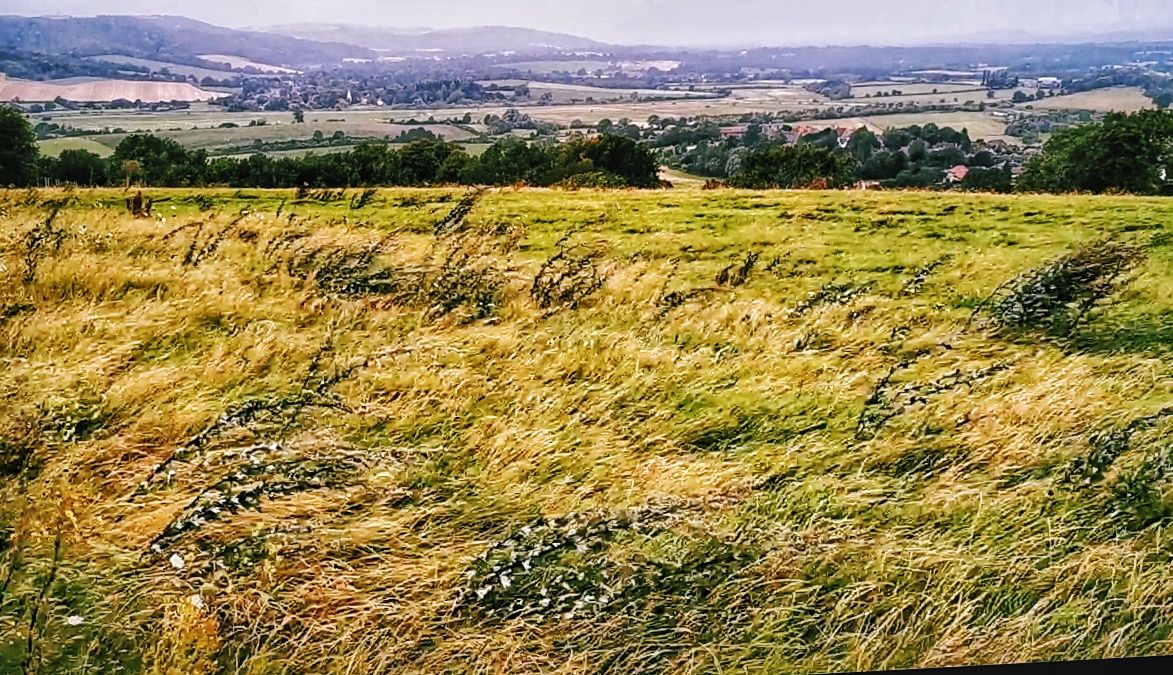
I grew up in a rural spot, an isolated hamlet of thatched cottages scattered around a large cow-pasture.
We used well-water. No one had running water. For drinking, cooking, washing, householders used water drawn from wells, or from rain-water butts.
One cottage had a spring in the garden next to their vegetable patch. There was no mains gas, piped drinking water, or electricity in Sedrup Green, Buckinghamshire, until the 1960’s.
At one side was Sedrup Farm. Sedrup used to be a Green. That’s to say, a grassy area over which local residents, mostly families of farm labourers, enjoyed the right to graze their livestock: donkey, cow, goat or sheep. Owning a horse was beyond the reach of the people.
In 1934, when my parents had bought their ‘country’ cottage 45 miles from London, a donkey had been housed in the room with its beaten earth floor adjacent to our kitchen.
These are the tranquil spaces of green fertility I remember and so clearly recall, as the 1940s melted into the hot summers of the 1950s.
The deep blue skies were mine to roam under. Places all mine to explore and to wonder at.
Tall only as the tallest grasses, my sphere of awareness, my operational horizon extended from my feet to my head and two paces forward.
Here movement and attention was always dominated by insect life!
If I had any aesthetic response to the endless multiplicity of insect markings and bright colouring, it was present as an admiration of their symmetry and in my absorption in their extreme detail.
What my toddler self, free to wander at will in complete security, was mainly given over to was attention to the discovery of the new.
My personal paradise was still untouched by the application of agricultural pesticides on industrial scales.
Insect life teemed. There was no question, no uncertainty about whether they would be seen outside my home, they were everywhere. On fresh cowpats, on, under and inside leaves.
Insects thronged the mixed grasses. Tree bark hid more, leaf litter almost heaved with insects. Their tiny winged squadrons dithered in shafts of sunlight. Mud puddles twitched to the dance of their skips. Larvae, big and small, ducked out of sight at my approach to ponds and rainwater butts.
If I moved very slowly at the foot of the old stack of straw near the boggy centre of the pasture, I might see tiny new frogs hopping about!
I didn’t catch the insects. I listened and looked at them. I wondered at their legs, their eyes, their hairs. I was fascinated to watch the way they articulated their many-legged segmented bodies.
I was specially drawn to the obvious questing curiosity displayed in the waving of their antennae. Of course I knew these were receptors. After all, cats and dogs have them. And why were our own human H-shaped ones fixed on rooftops, if not to capture TV signals?
So I asked myself what was it they were tuning into? Try as I might, I never detected the external sensory input that triggered their sudden disappearance by flight or jump.
From these beginnings, when I simply accepted the endless novelty of life forms that presented to my eyes, I began to ask questions of grown-ups.
I saw picture books with the stages in the life of a butterfly. Later on I went out with a magnifying glass. Then I looked at some of these animals under a microscope.
I pieced together enough of the story of the animate life I was immersing myself in to satisfy my basic curiosity and I carried on exploring, discovering.
I had no vision of myself in another frame of reference. I had no idea I was a little child in a paradise.
There was a depth of meaning and an intensity I brought to my examination of my bubble of vision which was not self-referential. I did not authorise my toddling enjoyment. I engaged in no internal conversation from alternative perspectives.
I remember nothing insistent or harassing about my mind-chatter at that age.
When I try to get inside my happy head again, I hear a kind of sing-song melody at low-volume, rather than words of conversation.
Today, some six-and-a-half decades later, I can blend with ease this old body of mine into that fresh, leggy boy’s body, as he walks so slowly among his grass-hoppers, crickets and ladybirds.
I can be with his mild boy brain, I can share in his thoughtless thoughts. I can thrill to his surprise as he focuses at millimetre level, closer than my old man’s eyes will function unaided today.
Though those insects are no more, and though most of their species’ descendents are no more, I still burn!
I burn with an incandescent, unending, overflowing gratitude for their brief, busy little lives.
I burn flameless bright with the love and compassion for all living sentient beings which their brief lives awoke in the heart of my little life forever
~ Love is present E v e r yN o w
THAT WAS THEN… AND NOW
꧁༺ ❀🌿🩶☘️❀ ༻꧂
And now I will soon be 80. Here, now, I examine new understanding I receive from a life lived in contact with butterflies, pupae, grass-hoppers, ladybirds…
I was escaping not from school or from my friends, but from my self. I immersed myself in mindfulness long before I became aware of any sort of commoditised fashion for mindfulness.
I immersed myself, I allowed myself completely to be lost to the Big Green, my own phrase for Mother Nature. I did so because some urge to discover impelled me. This went beyond a young man’s inrerest in finding out what the countryside looked like, or in testing my physical endurance.
In those days as a young teenager, I slipped so quickly into a pleasant walking reverie, that I never thought objectively about why or how this was so. I didn’t ask myself why I was impelled to do this, nor if I shared this strong experience with others.
Of course, I had no words then to qualify my thoughts. These days, I put my best endeavours towards sharing with others the vast power of peace and love I experience in the present moment, and which I call EveryNow.
My deep conviction that it is important to share this stems from my vivid memories of a wide range of delightful and beautiful sensory impressions I gained from toddling in the high summer grasses of a large lush, insect rich, cow pasture in front of the thatched cottage my parents owned and visited every weekend.
I began serious regular solo backpacking in 1978. To complement it and reinforce the experience, I started a powerful way to accentuate and appreciate the moment of recording a scene.
I count myself extremely fortunate that I have the gift of total recall of every moment I press the shutter when I take a photo in a state of awe and admiration. I can retrieve the instant, and, more than that, I feel the immediate sensory impressions surrounding the moment of shutter release.
Often I will be gratified to relive the entire circle of sensory, emotional, physical and locational subjective experience of the captured moment.
I have never analysed my solo walks and long cycle rides while at Frensham Heights school from this perspective of relived childhood bliss. The memories I’m writing about came back in conversation with a school friend.
Years of unselfconscious discipline of mindful focus on the natural world in my teens and twenties helped me fill up the reservoir of vocabulary which inspired my regular practice of written mindful journaling that I try to bring to my EveryNow blog.


 The View at 72+