Miz Maze & Breamore

near the Miz Maze

Breamore and Miz Maze – some lines in praise

Breamore is one of my favourite places in Dorset.

The charm of the place name of Breamore is that it will never get to be pronounced as it appears on paper, neither today, nor tomorrow, and this is how the locals would have it, as it always has been from times immemorial.

To a person who walks with receptivity and who has eyes to see, there are still surface characteristics, and traces of the workings and the worship by seasonal routines of the earliest settlers on these fertile furlongs.

Relics can be discerned of the nurture and respectful land management from their effect on the ground of ancient legs and hands, and in the way the landscape has been allowed to roll and unfold, as well as in the disposition of the extant flora, in particular the avenue of Yew Trees.

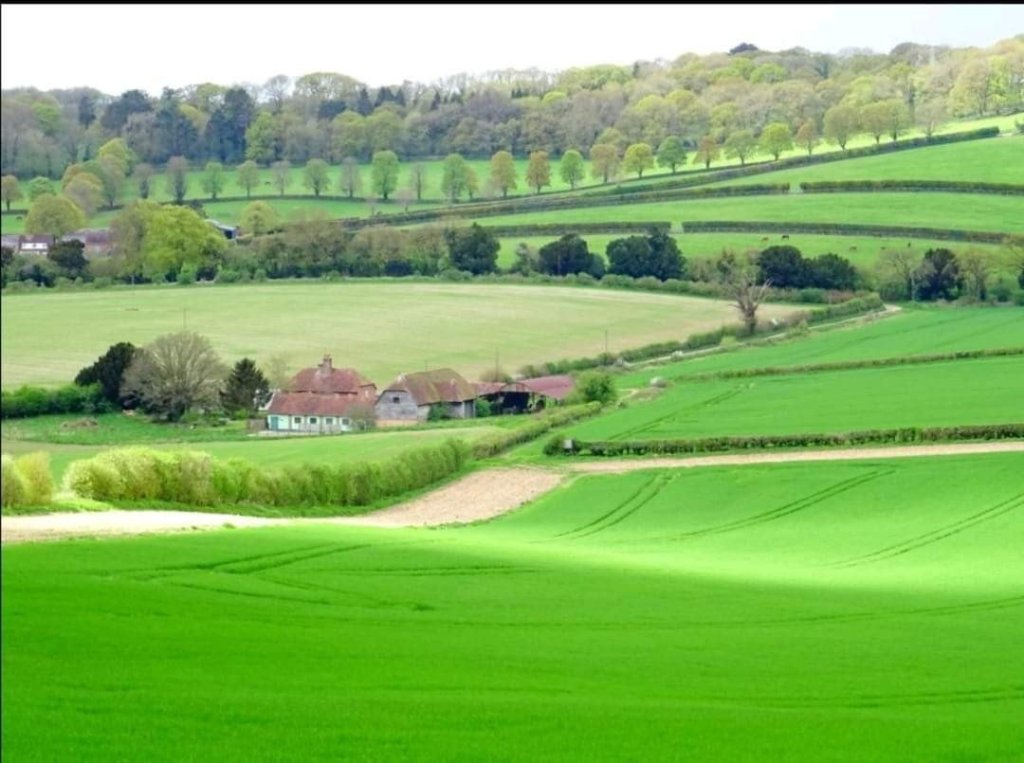
This view in my photo has none of the trees in question. I slid under barbed wire and down a bank to take this panorama about a hundred yards from the line of the Yew enclosed track.

They will all have been planted as borders along at least a mile of footway leading gently uphill to the Breamore Miz Maze, one of England’s eight surviving Neolithic turf mazes.

Though these Yews seen today are sadly disrespected, for the lack of people purposed with their health and well-being, each one in their ground-holding today stands witness to their continuous presence throughout centuries gone by.

Those days are long ago to our kind. The noble Yews count out time at four blinks-a-year. They remember when enough hands were living hereabouts to manage and maintain them.

Those ordinary land workers followed the path of working traditions established through customs of usage by their forebears, who had in their turn devoted part of their time to their duties to the Yew Trees.

These rites of care they performed alongside their other work out of respect for the wisdom of the folklore passed down from the ancients who had lived with the awe that the natural and magical and mystical properties of the Yew Trees inspired.

Any sapling requires a minimum of protection to survive on its way to maturity. Some of the trees along here are these days in a pitiably broken, delapidated state.

Nor you nor I need arboriculture to recognise neglect and disrespect where casual damage and overclimbing brambles are evident.

There are many full grown yews here. I see them as statements of ancient human will. Decision makers a long time ago intended them to be growing here, each in its place on either side of this thoroughfare, perhaps in perpetuity, as they would have had it in their minds’ view.

I see them in their shaded orderly procession as contrasted to the acres to the east and west whose unbroken flatness was created by machine under the will of other, more modern minds.

The lines in the landscape are still available to be seen. They are so empty and silent of oxen, of horse, and of men in their hardy boots, coarse-cloth clothes, head caps and gruff chit-chat.

In their landscape I believe I still see where they took themselves, one after the other on their working ways, mornings to and evenings from, season after season.

Every place of habitation, shelter for beast or man, place of veneration, memorial or worship, every roadbend, hillcrest, stream, dugout or hillock visible today were joined by footsteps following footsteps in lines of service and daily sacrifice.

I see time’s imprint all over these lands, either by design, or by default of neglect or disregard for the ancient patterns.

The land shapes are often readable marks, interpretable very much like the notes on an old music score. Here is pattern, rhythm, glory, major chords of root, and upthrust of choral gladness in the Sun’s light. Here too is destruction, cynical trashing that clashes a terrible dissonance against the greatness of this year’s delicate greening.

Wide open I pass by, and where I can pause my footfall on a noiseless day, I am like to hear the past speak up from the earth. I am with the people whose blood and bones it once nourished.

They are me. I am they. 

It is a simple, and often extremely poignant exchange of recognition, gratitude and kinship performed walking alone and in silence.

A brief study of the specialist maps which list ancient monuments, Neolithic and other earthworks, and Roman to Victorian road and field boundaries, is most revealing of the vast bustle of noises from beyond the past. Empty now of sound.

Love’s presence

The Breamore Miz Maze is one such place where lines of connection, ceremony and duty converged and do still converge, even if the lines today are carrying the feet of the curious, the nostalgic, the dog-walkers and the occasional intrepid lovers!

E v e r yN o w
Largesse of life abounding

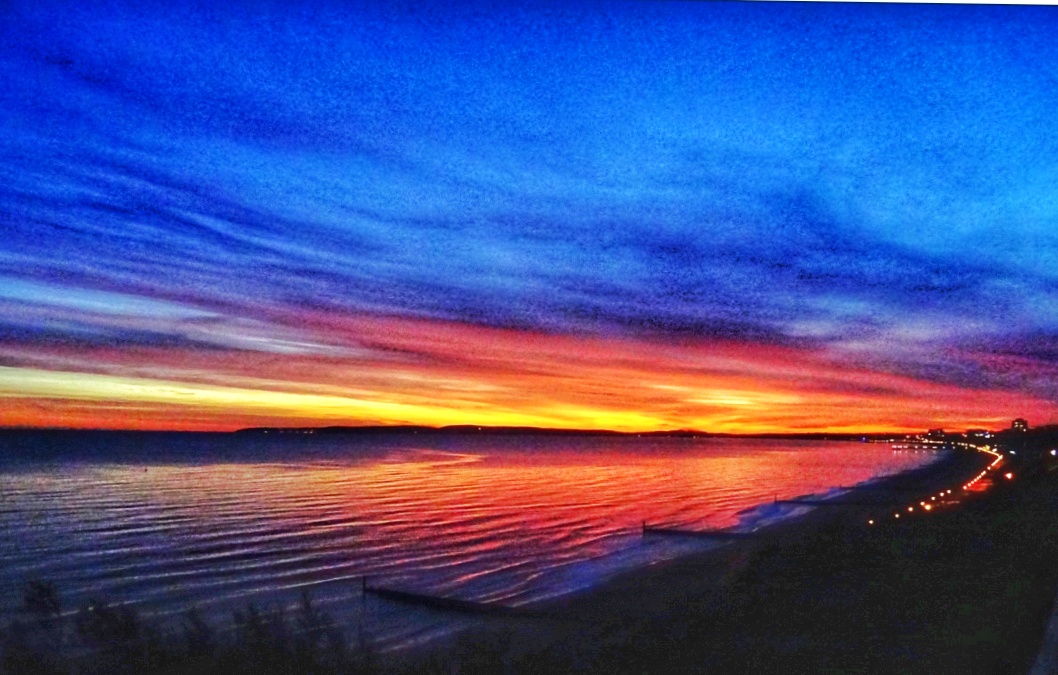
The revolving stage removes the Sun.

Distilled evaporations of daylight follow gaily, respectfully behind, while courtly silks and rich pastel satins flow in procession over the horizon

The stage revolves and,
motionless,
we are freely carried with it
on the curvature’s largesse

Happy are the fortunate few,
for their gaze is drawn upward toward darkness!

They receive the sudden grandiose gift of fecund Moon

Moon is sated by the Sun’s departed retinue of salmon flashes, great golds, carmine bloods, dusky pink and honey drooled yellows!

Largesse of life abounding to all who live and breathe

The time is come to seek fresh borning.
To Moon, I bow
To Moon, I kneel

While all around the freshening silences intertwine

Day and night come and go
See the sense of season
Sleep naked of reason
Old earth is new earth in the dark seed’s eye

~ and Love is present EveryNow

Some centuries ago near Tollard Royal

“Dull sublunary lovers’ love…” from The Kiss, by John Donne

This tree has begun to take root with me.

I’d taken some wrong turns on my solo hike. I began to find my bearings again. I was about a mile from a pretty stone-built village with a church, bus shelter and a public phone, where I’d agreed to rendezvous with a man at the end of his day’s golf at Tollard Royal for a lift back to the Compasses Inn, Tisbury. It was in 2013.

Following my nose, not any path, I descended from a ridge. I called to a young man seated in the yard of a huge farmhouse, and I asked the way to the village. He was well spoken. The impressive building was clearly centuries old.

I thanked him and about a half mile further and 50 yards off and to the left of the single track tree-lined lane stood the majestic tree in this photo.

The sense of its obvious undamaged longevity, its benign warmth and silent fertility, made me direct all of my attention to it. The afternoon was a hot one. A mare and her foal were standing in the shade nearby.

I caught something of its own ancient yet fresh pleasure at being safe and well for so very long in this particular place.

Five years later, I took the time to scrutinise Google Maps. I used Terrain and Satellite view on my smartphone. I followed remembered landmarks, beginning with the golf course near Tollard Royal, where my lift was coming from.

With the confirmation of Street View, and recall of the scenes I had paused to photograph in the little village, in under an hour I had located my tree!

It stands halfway between Berwick St John and the ancient farmhouse, which sits at the foot of a ridge – part of a watershed valley – at the end of Woodland Lane.

I cannot forget the friendliness I felt during the short time we were in each other’s company.

I long to say hallo again. Now I know I can. The round trip by bus from Bournemouth will take only half a day.

… … …

Here on a sunny day, 25 Feb, five-and-a-half years later, the story continues…

The weather and the auguries are propitious for undertaking the public transport journey.

I got off the bus at 2:30 on this Monday in the charming little village of Berwick St John, whose pub, the Talbot, is unfortunately closed Mondays.

The bus timetable allows three hours to find and re-friend my tree, some ten minutes walk away.

Alas, poor tree. Last year’s winter blasted and blew down its majestic crown. I look on reluctant to believe this is the same tree.

We all react to dramatic news with a spasm of disbelief. I see no limbs on the grass flood plain, no branch litter. With care the estate workers have removed them all. It is beyond doubt my tree, or its remnant, that is marking time here now.

We spend a while keening together. All is change.

I climb two fences, and make my way uphill to a circle of ancient beeches standing out on top of perhaps a man-made tumulus.

Here is a new bench, and surprisingly an unmarked, freshly dug grave. The occupant has a panoramic view over his estate.

I learn later, from “Pontibus”, my impeccably courteous lift, a teacher of Latin to ecclesiastics hereabouts, that the large vase of white lilies is Anka Dineley’s tribute to her beloved husband, Peter, recently deceased.

Indeed, after admiring the view for a short while from the heights of this sacred grove – surely it is a tumulus – I meet Widow Dineley. She has climbed here to tend to the grave, and we shared a moment of respect for the dead.

Among the photos I took on this Sun-filled early spring day, full of the signs of returning life, was one of the ground at my feet near this grave.

Shotgun cartridges, green and red, were trodden into the ground by those who had come here to gain the advantage of height against their prey.

Later that day I came to see the whole picture. This day of presence in solitude and solitary witness showed to me yet again both strident and subtle signs of the changes in every place I tread, in every horizon’s direction I am drawn to by my seven decades of gazing.

With the sun going down, I hitch-hiked the sparse traffic in both directions, rather than wait more than an hour for the last bus to Salisbury.

Along the dozen miles to Nunton, my driver and I exchanged brief lives in the delicate, age-old customary codes of respect between travelling strangers.

I was told the farm and its large estate lands I had stumbled across so long ago was owned by Francis and Peter Dinely, long-time important actors in this country stage. Peter, a member of this old, respected land-owning family, is now mourned by his widow.

The tree is toppled, reduced all suddenly from its former nobility by the winds of time.

The chalk downland landscape here, with its life-cycle complement of trees, boundary stones, archeology of the Mesolithic, Neolithic and Bronze Ages, carries its prehistoric ramparts and funerary mounds like music notes scored on the earth.

Slower than a giant’s breath, the notes are being rearranged, muted, and reconstructed by the decades.

The stone boxes people live in are changing season by season, as the new inhabitants sing the old songs according to melodies unrecognisable to those at rest under their hallowed ground.

My tree friend is still my friend. We will remain linked. Our separate life cycles are forever united.

We are both a little more blasted. We have changed together. These felled angels are not to be pitied, they do not look to us to possess a life they do not own.

This land echoes to the orchestration of universal country sounds familiar to every ancestor. The soundscape of humility and gratitude for living – cawing crows, piping robins, wildfowl screech, siffle of hovering hawk.

What we share in common, with tacit friendliness my tree and I, is the sacred sweet precession – the continuum of change.

~ Love is present EveryNow