I get it. Some of our remotest distant ancestors set much store by the creation and maintenance of these turf and stone and rock carved mazes.
They also venerated their uncomplicated maze motifs in their decorative jewellery, metalwork. I speculate how they danced their Maze dances by firelight and feasting.
We see landscapes where the wind-blown engravings of their Maze representations question our eyes today, thousands of years after they were graven onto vertical faces of stone.
It seems perfect to me that the depictions we are shown are devoid of people walking or standing inside the boundaries they figuratively present.
Only visualise the boundaries as representations of our journey.
Beginning. End. Mystery.
The viewer sees the journey. The Journey invites the viewer.
Life is the universal invitation to take the simplest line between two footsteps and repeat until the sun has set for the last time.
There is no question; the answers throng the lifelines.
No more mysterious and no more obvious challenge exists than to step out onto the lines of our lives, foot by foot, word by word.
When our hearts do this, we find peace through the acceptance of all eventualities, and our blood flows us on the way of the Maze.
The face of the carved Maze is weathered by so many cycles of the sun and moon. It is not raised high for eyes to see from all horizons, like the pyramids.
The Maze is a factual organic, circular statement. It reads, “That which is to be begun, will end to begin again endlessly.”
No monument shows with such understated elegance and enduring eloquence the peace and the humble privilege that is in the living of life.
I read the Maze as an open invitation to infinity. Within the limits of vision of my own boundaries, I return to my little mantra:
The charm of the place name of Breamore is that it will never get to be pronounced as it appears on paper, neither today, nor tomorrow, and this is how the locals would have it, as it always has been from times immemorial.
To a person who walks with receptivity and who has eyes to see, there are still surface characteristics, and traces of the workings and the worship by seasonal routines of the earliest settlers on these fertile furlongs.
Relics can be discerned of the nurture and respectful land management from their effect on the ground of ancient legs and hands, and in the way the landscape has been allowed to roll and unfold, as well as in the disposition of the extant flora, in particular the avenue of Yew Trees.
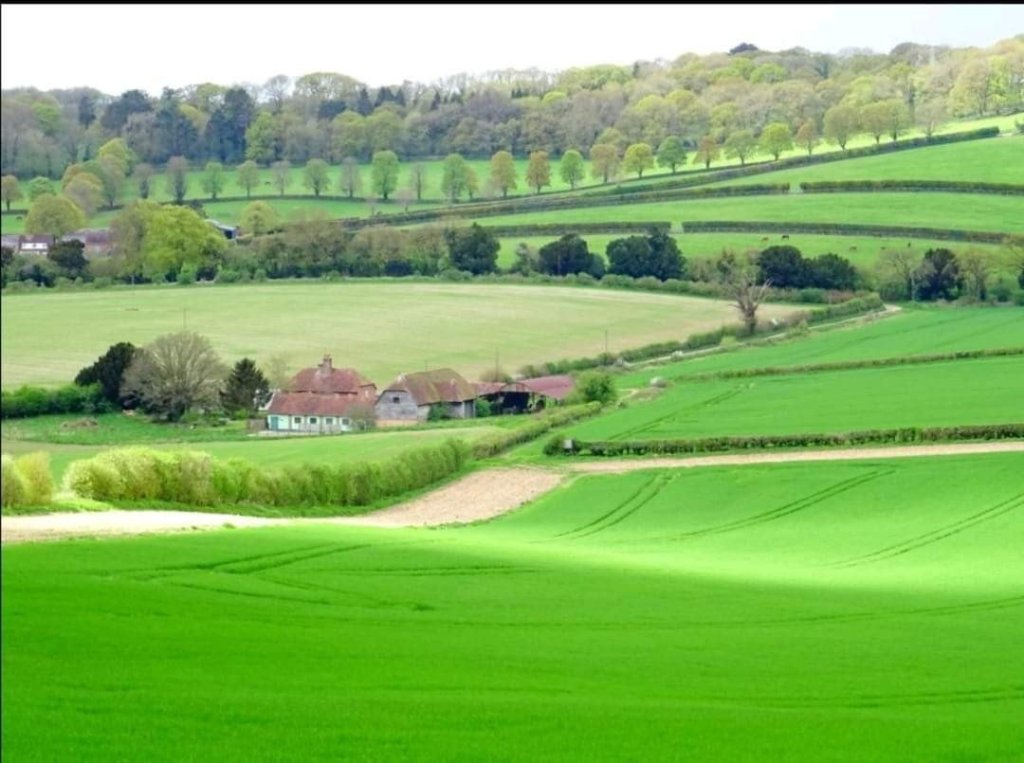
This view in my photo has none of the trees in question. I slid under barbed wire and down a bank to take this panorama about a hundred yards from the line of the Yew enclosed track.
They will all have been planted as borders along at least a mile of footway leading gently uphill to the Breamore Miz Maze, one of England’s eight surviving Neolithic turf mazes.
Though these Yews seen today are sadly disrespected, for the lack of people purposed with their health and well-being, each one in their ground-holding today stands witness to their continuous presence throughout centuries gone by.
Those days are long ago to our kind. The noble Yews count out time at four blinks-a-year. They remember when enough hands were living hereabouts to manage and maintain them.
Those ordinary land workers followed the path of working traditions established through customs of usage by their forebears, who had in their turn devoted part of their time to their duties to the Yew Trees.
These rites of care they performed alongside their other work out of respect for the wisdom of the folklore passed down from the ancients who had lived with the awe that the natural and magical and mystical properties of the Yew Trees inspired.
Any sapling requires a minimum of protection to survive on its way to maturity. Some of the trees along here are these days in a pitiably broken, delapidated state.
Nor you nor I need arboriculture to recognise neglect and disrespect where casual damage and overclimbing brambles are evident.
There are many full grown yews here. I see them as statements of ancient human will. Decision makers a long time ago intended them to be growing here, each in its place on either side of this thoroughfare, perhaps in perpetuity, as they would have had it in their minds’ view.
I see them in their shaded orderly procession as contrasted to the acres to the east and west whose unbroken flatness was created by machine under the will of other, more modern minds.
The lines in the landscape are still available to be seen. They are so empty and silent of oxen, of horse, and of men in their hardy boots, coarse-cloth clothes, head caps and gruff chit-chat.
In their landscape I believe I still see where they took themselves, one after the other on their working ways, mornings to and evenings from, season after season.
Every place of habitation, shelter for beast or man, place of veneration, memorial or worship, every roadbend, hillcrest, stream, dugout or hillock visible today were joined by footsteps following footsteps in lines of service and daily sacrifice.
I see time’s imprint all over these lands, either by design, or by default of neglect or disregard for the ancient patterns.
The land shapes are often readable marks, interpretable very much like the notes on an old music score. Here is pattern, rhythm, glory, major chords of root, and upthrust of choral gladness in the Sun’s light. Here too is destruction, cynical trashing that clashes a terrible dissonance against the greatness of this year’s delicate greening.
Wide open I pass by, and where I can pause my footfall on a noiseless day, I am like to hear the past speak up from the earth. I am with the people whose blood and bones it once nourished.
They are me. I am they.
It is a simple, and often extremely poignant exchange of recognition, gratitude and kinship performed walking alone and in silence.
A brief study of the specialist maps which list ancient monuments, Neolithic and other earthworks, and Roman to Victorian road and field boundaries, is most revealing of the vast bustle of noises from beyond the past. Empty now of sound.
Love’s presence
The Breamore Miz Maze is one such place where lines of connection, ceremony and duty converged and do still converge, even if the lines today are carrying the feet of the curious, the nostalgic, the dog-walkers and the occasional intrepid lovers!
I and some others who took part in the guided Tree Walk with Anthony Goh one morning at Colourfest in 2013, intensely felt the experience and came away with deep lasting positive impressions from the trees themselves.
The two most tactile tangible realities we are all intimately in connection with throughout our existence are other human beings within the animal world, and grass, flowers and trees, as well as the plants we eat as food in the world of vegetables.
I publish this again here in thanks to Anthony. Before that day, a tree was an item of landscape, seen, but unrecognised, unacknowledged.
— Earth Mother bore our shoeless dancing feet with tender green love. Sky Father trees, all unconscious of their benign majesty, held millions of green solar flags high over us.
— The pinnacle of bliss at Colourfest 2013, was our experience with Tree Walk on Sunday, two by two, now eyes shut, now eyes open, touching, embracing, the breeze of bells carried in the warm air from the Wimborne St Giles church. It deeply moved all who took part, whether first-timers like myself, or not.
— The shockingly blissful conjunction of ourself with trees to the serious and gentle promptings of Anthony Goh was, in one word, thrilling.
— From that day on, my relationship with trees has been changed forever. For one thing, trees to me are no longer there like items which happen to be in my line of sight outside of me.
Trees at last I know to be fellow beings. Every one has a life story, a unique identity – a Treesonality.
Every one has an inner smile which I know I can share just by spending a little quiet time together.


 The View at 72+